
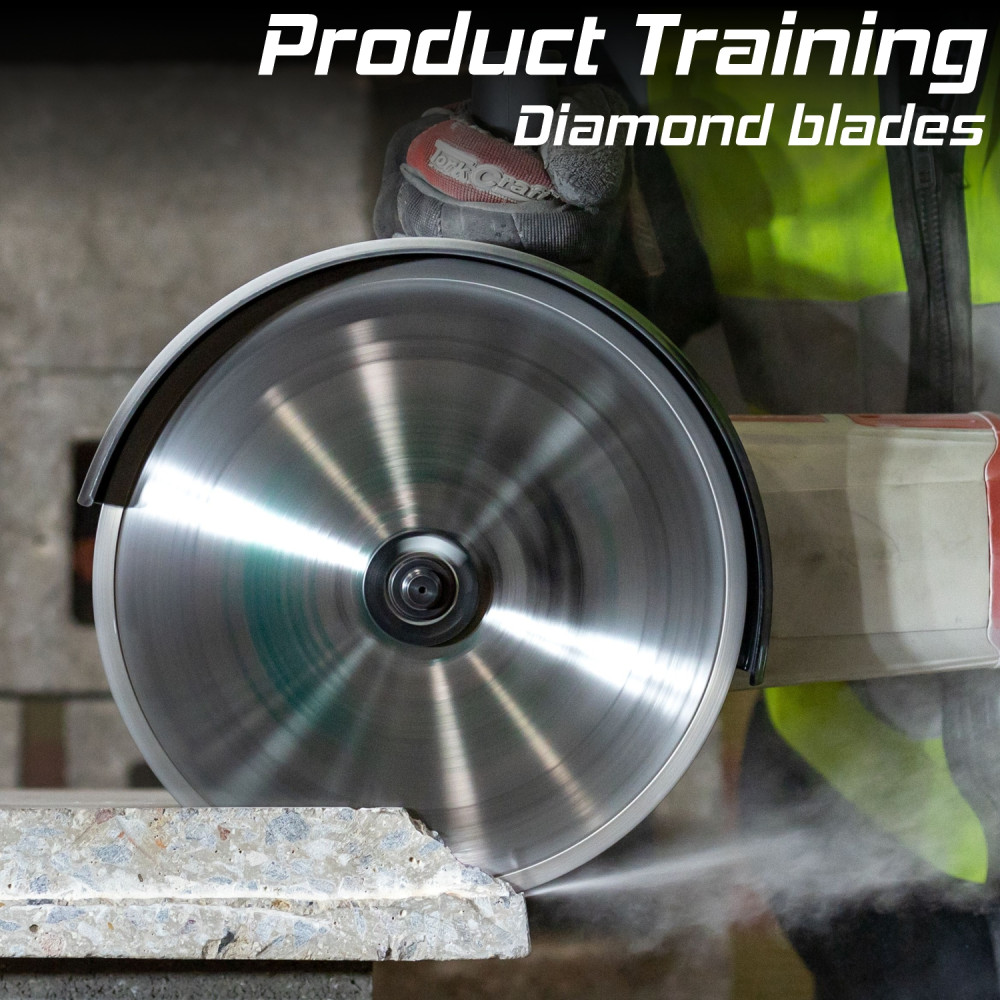
Objective:
To provide participants with a strong understanding of diamond blade construction, material suitability, cutting techniques, safety practices, troubleshooting, and customer guidance—enabling them to confidently recommend and use diamond blades in professional applications.
Modules:
- Introduction to Diamond Blades:
- What diamond blades are and how they differ from abrasive blades.
- Overview of applications: construction, tiling, masonry, plumbing, renovation, landscaping.
- Benefits of diamond technology: faster cutting, longer life, cleaner edges.
- What diamond blades are and how they differ from abrasive blades.
- Diamond Blade Construction:
Training covers each critical component:- Steel Core – precision-cut, tensioned body for stability.
- Diamond Segments – synthetic diamonds bonded with metal powders.
- Bond (Matrix) – controls how quickly diamonds are exposed during cutting.
- Gullets – space for debris removal and cooling.
- Segment Types – segmented, turbo, continuous rim.
- Segment Types & Their Applications:
Understanding the uses of each diamond blade design:- Segmented Rim
- Fast cutting, aggressive.
- Ideal for concrete, brick, pavers.
- Best for dry cutting with airflow cooling.
- Turbo Rim
- Mix of speed and cleaner finish.
- Suitable for stone, masonry, and some tiles.
- Improved airflow and chip removal.
- Continuous Rim
- Smoothest finish, minimal chipping.
- Designed for wet cutting.
- Ideal for ceramics, porcelain, marble, granite.
- Vacuum-Brazed / Electroplated Blades
- Excellent for speciality materials (fibreglass, plastics, metals).
- Very fast, aggressive initial cutting.
- Bond Hardness Explained:
- Soft bond → cuts hard materials (e.g., porcelain, granite).
- Hard bond → cuts soft abrasive materials (e.g., asphalt, sandstone).
- Choosing the wrong bond leads to rapid wear or glazing.
- Soft bond → cuts hard materials (e.g., porcelain, granite).
- Material-Specific Blade Selection:
Participants learn to match blades to materials:- Ceramic & Porcelain Tiles → continuous rim.
- Granite, Marble, Natural Stone → turbo or continuous rim.
- Concrete (green, cured, reinforced) → segmented turbo.
- Bricks & Pavers → segmented.
- Asphalt → very soft bond blades with deep gullets.
- Metal / Multi-material → vacuum-brazed blades.
- Ceramic & Porcelain Tiles → continuous rim.
- Dry vs. Wet Cutting:
- Dry cutting:
- Used with segmented/turbo rims.
- Requires intermittent cutting to prevent overheating.
- Not ideal for delicate materials that chip easily.
- Wet cutting:
- Required for continuous rim tile blades.
- Reduces dust, heat, and blade wear.
- Essential for porcelain and glass.
- Dry cutting:
- Understanding Blade Diameter & Arbour
- Matching blade size to machine capacity (115mm, 125mm, 230mm, 300mm, etc.).
- Ensuring correct arbor size (22.23mm, 25.4mm, etc.).
- RPM limits—never exceed blade speed rating.
- Matching blade size to machine capacity (115mm, 125mm, 230mm, 300mm, etc.).
- Safety Training:
- Inspecting the blade for cracks, missing segments, or warping.
- Install the blade in the correct rotation direction.
- Using proper PPE: eye, ear, dust, and hand protection.
- Ensuring machine guards are in place.
- Avoid side pressure or twisting during cuts.
- Allow the blade to reach full speed before cutting.
- Inspecting the blade for cracks, missing segments, or warping.
- Cutting Techniques & Best Practices:
Participants learn how to maximise blade performance:- Let the blade do the work—avoid excessive pressure.
- Use score-cutting on tiles to prevent chipping.
- Allow cooling pauses during dry cuts.
- Maintaining a consistent feed rate.
- Proper support of the workpiece to avoid binding.
- Troubleshooting Common Issues:
Training includes diagnosis and corrective action:- Blade Wearing Too Fast:
- Wrong bond hardness.
- Too much pressure.
- Cutting overly abrasive material.
- Wrong bond hardness.
- Glazing (Blade Won’t Cut)
- Bond too hard for the material.
- Remedy: sharpen the blade using a soft abrasive block or sandstone.
- Bond too hard for the material.
- Chipping
- Wrong blade type.
- Cutting too fast.
- Not using water when required.
- Overheating / Warping
- Insufficient cooling.
- Incorrect RPM or feed rate.
- Insufficient cooling.
- Blade Wearing Too Fast:
- Sales & Customer Guidance:
Equip sales teams with practical knowledge:- Identify the customer’s material FIRST.
- Establish whether cutting will be wet or dry.
- Recommend the right bond hardness and rim type.
- Explain why premium blades save time and money.
- Provide usage tips to extend blade life.
- Identify the customer’s material FIRST.
- Hands-On Demonstration (Optional)
- Cutting sessions on tile, concrete, and masonry.
- Technique practice (straight cuts, plunge cuts).
- Observing material-specific blade behaviour.
- Certification:
Participants can receive a Diamond Blade Product Specialist Certificate, demonstrating:- Ability to match blade to material.
- Understanding of wet vs dry cutting.
- Safe operation and troubleshooting knowledge.
Outcome:
After completing the training, participants will:
- Understand diamond blade technology and performance factors.
- Recommend the correct blade for any material or machine.
- Operate and maintain diamond blades safely and effectively.
- Troubleshoot issues confidently and advise customers with authority.
- Increase professional credibility and improve customer satisfaction.
| Event Type | Training_course |
|---|---|
| Organiser Name | Mbalenhle Maroka |
| Organiser Email | mbalenhlem@vermontsales.co.za |
| Organiser Telephone | 0113147711 |
| Dates | 2026-03-17 09:00:00 - 2026-03-17 15:00:00 |
| Class/Event Length | 6 Hours |
| Location | 192 Tsessebe Crescent Midrand Gauteng South Africa -25.949700022046105 , 28.140760817554153 |
| Seats available | 13 |
17 March 2026
Diamond blade Training - Gauteng
Available Options
Disclaimer: Please ensure that you have read and understood the terms and condition associated with this event. Please access the terms here
Tags:
Training